
Technical information
Mirrors
Mirrors cut to size from silvered float glass: plain silver, tinted (grey, bronze, blue, green) and antique. Polished or bevelled edges, holes for fixings, and shaped corners, from small panels to full mirror walls.
At a glance
- Glass
- Bronze Antique Mirror 4, 6 mm; Bronze Tint Mirror 4, 6 mm; Grey Tint Antique Mirror 4, 6 mm; Grey Tint Mirror 4, 6 mm; Griseo Antique Mirror 4, 6 mm; Mirror 4, 6 mm; Silvered Antique Mirror 4, 6 mm; Venetian Antique Mirror 4, 6 mm
- Toughening
- Not toughened: mirror is silvered float glass.
- Edges
- Polished edges or Bevelled
- Holes and cut-outs
- 6 to 100 mm across, in even sizes; for mirror screws and fixings
- Sizes
- From 100 x 100 mm; online up to 3,000 x 2,200 mm, larger pieces priced by hand
- Priced
- Online, as you configure it
Where it is used
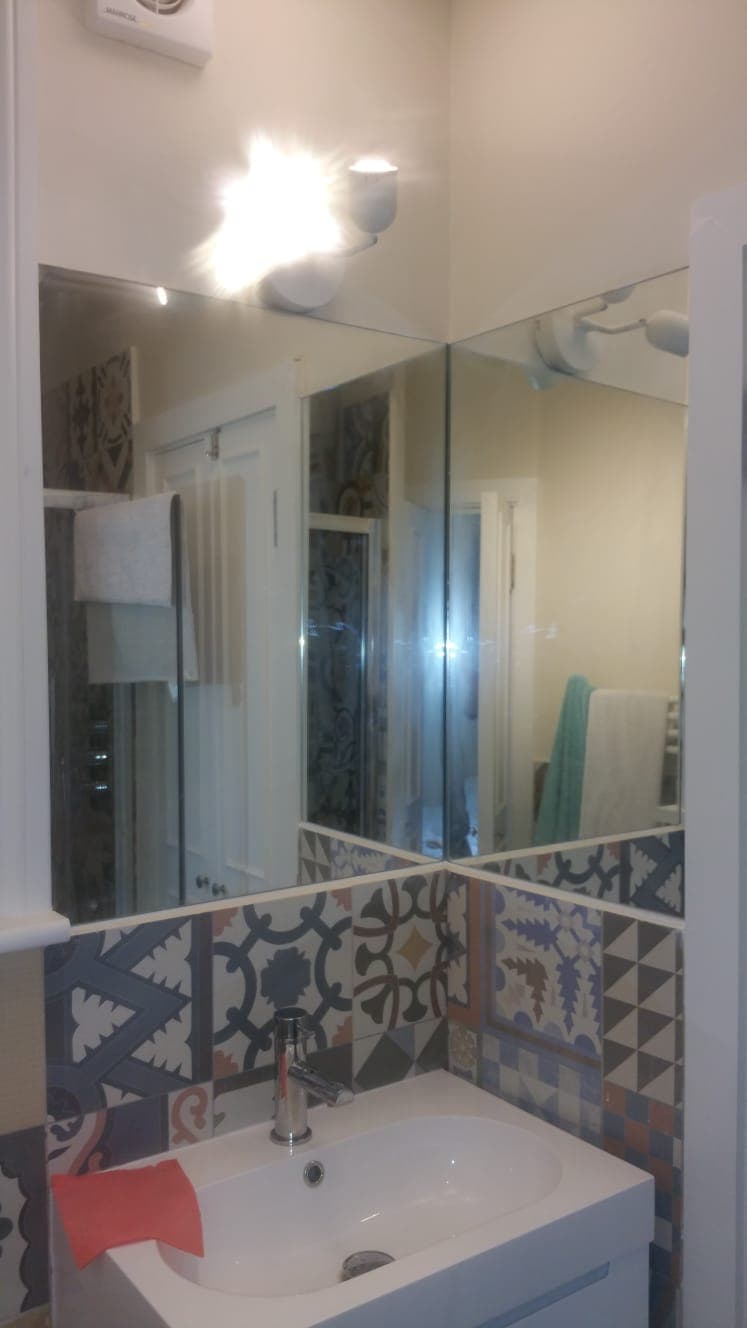
- Bathroom and cloakroom mirrors
- Gym and studio mirror walls
- Hallways and dressing rooms
- Shopfitting and bars
- Antique mirror for cabinets and feature walls
How it is priced
Priced online: enter the size, the edge and any holes in the configurator. Mirror walls and unusual shapes are drawn and priced by hand.
What we supply
Glass in our catalogue today
- Bronze Antique Mirror
- 4 mm, 6 mm
- Bronze Tint Mirror
- 4 mm, 6 mm
- Grey Tint Antique Mirror
- 4 mm, 6 mm
- Grey Tint Mirror
- 4 mm, 6 mm
- Griseo Antique Mirror
- 4 mm, 6 mm
- Mirror
- 4 mm, 6 mm
- Silvered Antique Mirror
- 4 mm, 6 mm
- Venetian Antique Mirror
- 4 mm, 6 mm
Mirror types
- Silvered mirror
- Clear silvered float glass.
- Tinted mirror
- Grey, bronze, blue and green tinted glass, silvered.
- Antique mirror
- Mirror with an aged, mottled silvering.
Edges
- Polished edges
- Ground and polished flat.
- Bevelled
- A sloping polished border around the face.
Processing and the build-up
- Glass
- Silvered float glass to BS EN 1036-1. Mirror is not toughened.
- Holes
- For mirror screws and fixings, drilled before delivery.
- Minimum size
- 100 x 100 mm, the smallest piece we hold safely on the cutting table.
Regulations
Approved Document K, section 5 (requirement K4)
Glazing in a critical location must break safely (BS EN 12600 class 3 or better), be robust, be in small panes, or be protected. Critical locations: any glass in a door or within 300 mm of a door edge up to 1500 mm above the floor, and any glass in a wall up to 800 mm above the floor. A pane wider than 900 mm in a door or door side panel needs class 2. A mirror in a door or low on a wall is in a critical location: it needs a safety backing that gives it an impact class, or a position outside the zone.
England. This section took over the former Approved Document N.
Installation
- Fix with an adhesive or silicone labelled safe for mirrors. Acetic silicone and solvent adhesives eat the silver backing and show as dark patches.
- Large mirrors also need mechanical support: a bottom channel, clips or screws, not adhesive alone.
- Fix to a dry, flat wall and leave an air gap behind mirrors in bathrooms so damp does not sit against the backing.
Care and cleaning
- Spray the cleaner onto the cloth, not onto the mirror, so liquid does not run into the edges.
- Dry the edges after cleaning. Water and ammonia or vinegar cleaners left on the edges cause black edge, the silver lifting from the glass.
- Never use abrasive pads or powders.
Questions
Can a mirror be toughened?
Not once it is silvered. Where a mirror sits in a door or low on a wall, ask us about a safety-backed mirror for that position.
What is black edge?
Dark marks creeping in from the edge of a mirror, where moisture or the wrong cleaner or adhesive has lifted the silver. Mirror-safe adhesive and dry edges prevent it.
Which thickness?
4 mm suits small framed mirrors; 6 mm is stiffer and flatter for wall mirrors and mirror walls.
Standards that apply
| Standard | What it covers |
|---|---|
| BS EN 1036-1Glass in building. Mirrors from silver-coated float glass for internal use | Silvered mirror glass: the silver and protective backing layers, quality and the edge corrosion test. |
| BS EN 572Glass in building. Basic soda lime silicate glass products | Float glass (part 2) and patterned glass (part 5): the base glass every other product starts from, its dimensions and quality. |
| BS EN 12600Glass in building. Pendulum test. Impact test method and classification for flat glass | The impact test that classes safety glass. The class is written X(Y)Z: X and Z run from 3 (lowest drop height) to 1 (highest); Y is how it breaks: A like ordinary glass, B holding together like laminated glass, C in small pieces like toughened glass. |
Documents
The specification sheet carries this page's content with today's catalogue figures, in three printable pages.