
Technical information
Shower enclosures and screens
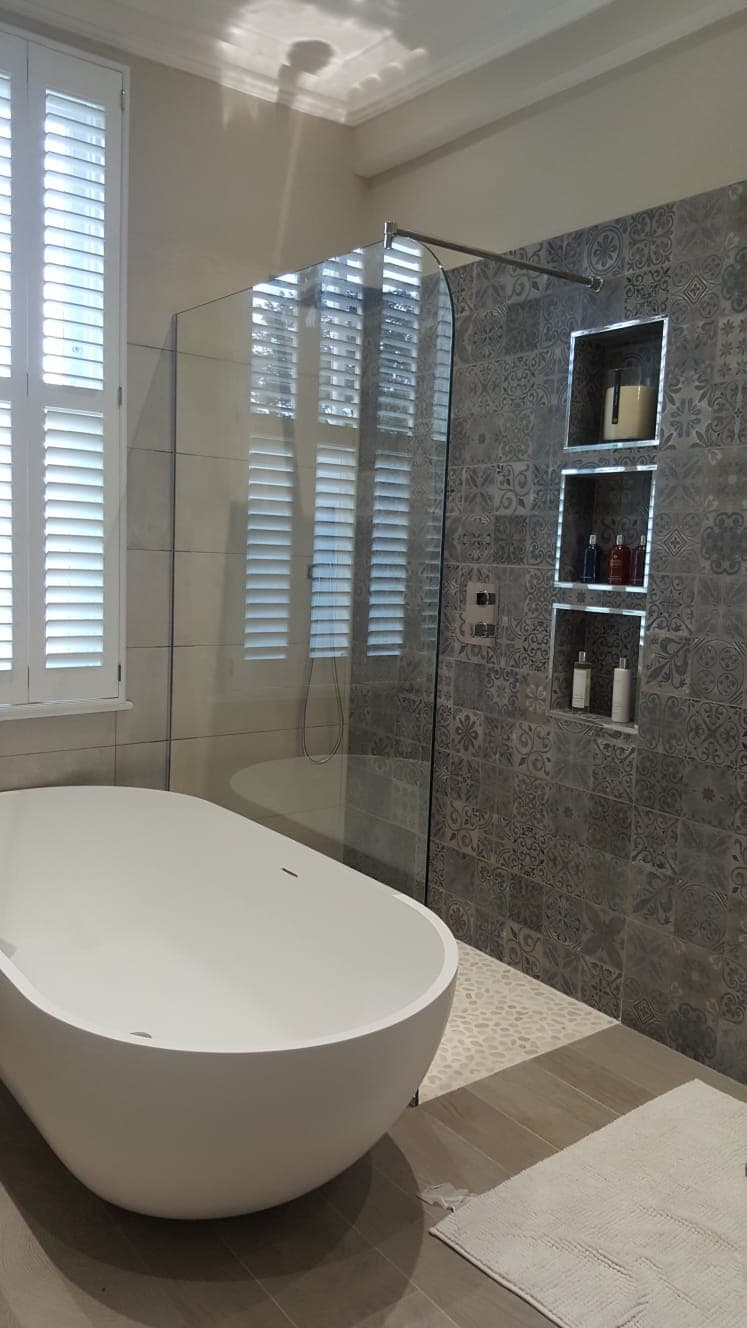
Made-to-measure shower glass: bath screens, fixed walk-in screens and enclosures with a hinged door. Every panel is toughened safety glass with polished edges, cut to your walls, with the hinge and clamp cut-outs for the hardware you choose.
At a glance
- Glass
- Bronze tint 8, 10 mm; Clear Glass 8, 10 mm; Fluted (Reeded) Glass 10 mm; Grey tint 8, 10 mm; Satin Glass 10 mm
- Toughening
- Toughened safety glass to BS EN 12150, with polished edges. Every shower and bath panel we make is both.
- Edges
- Polished edges
- Holes and cut-outs
- 6 to 100 mm across, in even sizes; for handles and knobs, with hinge and clamp cut-outs
- Sizes
- From 300 x 150 mm; online up to 3,000 x 2,200 mm, larger pieces priced by hand
- Priced
- Online, as you configure it
Where it is used
- Bath screens
- Walk-in and wet-room screens
- Enclosures with a hinged door
- Screens under a sloping ceiling (raked)
How it is priced
Priced online: choose the layout, glass and hardware in the configurator and the price updates as you go. Unusual shapes and sizes outside the online range are priced by hand.
What we supply
Glass in our catalogue today
- Bronze tint
- 8 mm, 10 mm
- Clear Glass
- 8 mm, 10 mm
- Fluted (Reeded) Glass
- 10 mm
- Grey tint
- 8 mm, 10 mm
- Satin Glass
- 10 mm
Layouts
- Bath screen
- A single panel over the bath.
- Fixed screen
- A fixed walk-in panel, or a screen beside the door.
- Shower enclosure
- A fixed panel with a hinged door beside it.
- Raked top
- Any panel can follow a sloping ceiling.
Processing and the build-up
- Toughening and edges
- Toughened safety glass to BS EN 12150-1 with polished edges, on every shower and bath panel.
- Hinge and clamp cut-outs
- Cut to the hardware's own template, so the hinge sits where the hardware maker intends.
- Holes
- For handles and knobs. Holes follow the BS EN 12150-1 limits for toughened glass: at least as wide as the glass is thick, and clear of edges and corners by a multiple of the thickness. Our drawing checks every position before cutting.
- Made to measure
- Toughened glass cannot be cut, drilled, notched or edge-worked after it is toughened. Every size, hole and cut-out is fixed on the drawing before the glass is made.
Regulations
Approved Document K, section 5 (requirement K4)
Glazing in a critical location must break safely (BS EN 12600 class 3 or better), be robust, be in small panes, or be protected. Critical locations: any glass in a door or within 300 mm of a door edge up to 1500 mm above the floor, and any glass in a wall up to 800 mm above the floor. A pane wider than 900 mm in a door or door side panel needs class 2.
England. This section took over the former Approved Document N.
Installation
- Walls must be plumb and the tray or floor level and fully supported before the glass is measured. Out-of-square walls are measured and drawn as they are.
- Fix hinges and clamps into solid backing or the wall maker's recommended anchors, never into tile alone.
- Seal with a sanitary-grade neutral-cure silicone after the glass is set. Leave the silicone 24 hours before the shower is used.
- Check the door's swing and its seal with the door fully open and closed before the silicone is applied.
Care and cleaning
- Squeegee the glass after each shower. Most marks on shower glass are limescale left by drying water.
- Clean weekly with a mild non-abrasive bathroom cleaner. For limescale, use a diluted descaler made for glass, then rinse.
- Never use scouring pads, powders or bleach-based mould cleaners on the glass or the hinges.
- Wipe chrome and brass hardware dry. Strong descalers damage plated finishes.
Questions
Which thickness should I choose?
We make shower glass in 8 and 10 mm. Larger fixed panels and frameless doors are often made in 10 mm for their weight and stiffness; the hardware you choose names the thicknesses it holds.
Is shower glass always toughened?
Yes. Every shower and bath panel we make is toughened safety glass with polished edges.
Can the glass follow a sloping ceiling?
Yes. Any panel can have a raked top; enter the two heights in the configurator.
Standards that apply
| Standard | What it covers |
|---|---|
| BS EN 12150-1Glass in building. Thermally toughened soda lime silicate safety glass. Definition and description | What toughened safety glass is, its fragmentation test, flatness and edge work, and the limits for holes and notches. Every toughened pane carries a mark naming the standard. |
| BS EN 14428Shower enclosures. Functional requirements and test methods | What a shower enclosure must do, including its stability, its resistance to impact and the safety glass it is made with. |
| BS EN 12600Glass in building. Pendulum test. Impact test method and classification for flat glass | The impact test that classes safety glass. The class is written X(Y)Z: X and Z run from 3 (lowest drop height) to 1 (highest); Y is how it breaks: A like ordinary glass, B holding together like laminated glass, C in small pieces like toughened glass. |
| BS 6262-4Glazing for buildings. Code of practice for safety related to human impact | Where safety glass is needed in buildings and how to select it. |
Documents
The specification sheet carries this page's content with today's catalogue figures, in three printable pages.