
Technical information
Glass splashbacks
Toughened glass cut to your wall behind a hob, sink or worktop: back-painted in the colour you choose, or as a silvered, tinted or antique mirror. The paint is on the back face, so the front is plain glass that wipes clean, with cut-outs for sockets and switches.
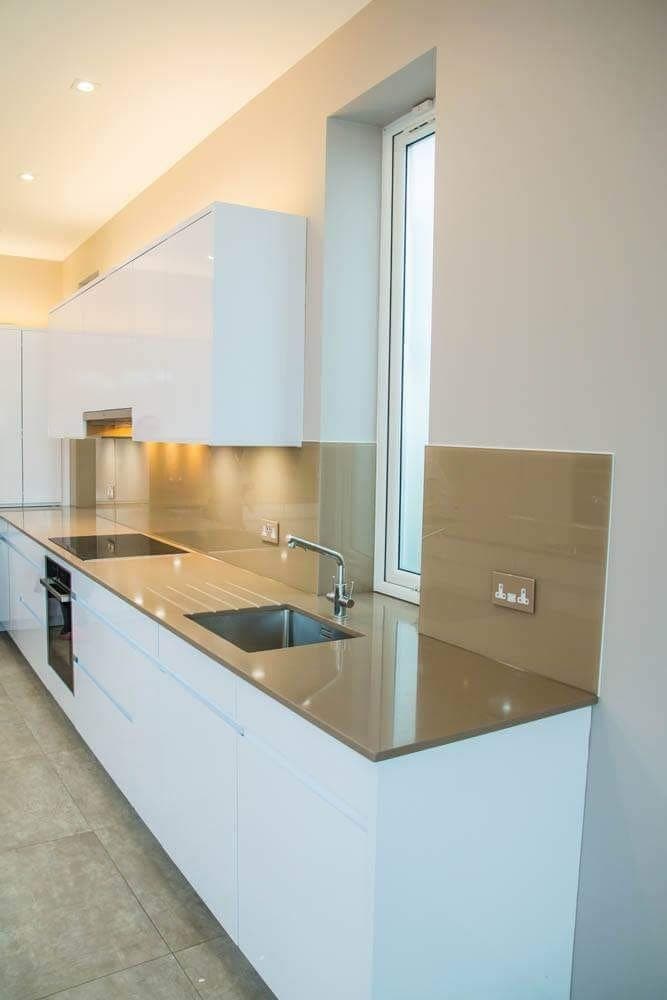
At a glance
- Glass
- Antique Mirror Splashback 6 mm; Back Painted Glass 6 mm; Clear Glass 6 mm; Clear TXD Glass 6 mm; Opti-white (low iron) 6 mm; Silvered Mirror Splashback 6 mm; Tint Mirror Splashback 6 mm
- Toughening
- Toughened safety glass to BS EN 12150-1 on every piece.
- Edges
- Polished edges
- Holes and cut-outs
- 6 to 100 mm across, in even sizes; socket and switch cut-outs, and holes
- Sizes
- From 300 x 150 mm; online up to 3,000 x 2,200 mm, larger pieces priced by hand
- Priced
- Online, as you configure it
Where it is used
- Behind a hob or cooker
- Behind a sink and along a worktop
- Bathroom and utility walls
- Bars and shop counters
How it is priced
Priced online: enter the wall sizes, the colour and the socket cut-outs in the configurator. Large walls are drawn from our template or a measure visit and priced by hand.
What we supply
Glass in our catalogue today
- Antique Mirror Splashback
- 6 mm
- Back Painted Glass
- 6 mm
- Clear Glass
- 6 mm
- Clear TXD Glass
- 6 mm
- Opti-white (low iron)
- 6 mm
- Silvered Mirror Splashback
- 6 mm
- Tint Mirror Splashback
- 6 mm
Glass
- Coloured splashback
- Back-painted toughened glass in the colour you choose. Low-iron glass shows a colour truest, without the green tint of ordinary glass.
- Mirror splashback
- Silvered, tinted or antique mirror.
Cut-outs
- Sockets and switches
- Cut to the faceplate's size so the plate covers the cut edge.
Processing and the build-up
- Toughening
- Coloured glass splashbacks are toughened to BS EN 12150-1, as they sit beside heat.
- Painting
- The colour is applied to the back face of the glass, so the front stays plain glass.
- Cut-outs and holes
- Sockets and switches are cut out to their positions on our drawing. Holes follow the BS EN 12150-1 limits for toughened glass: at least as wide as the glass is thick, and clear of edges and corners by a multiple of the thickness. Our drawing checks every position before cutting.
- Made to measure
- Toughened glass cannot be cut, drilled, notched or edge-worked after it is toughened. Every size, hole and cut-out is fixed on the drawing before the glass is made.
Regulations
Approved Document K, section 5 (requirement K4)
Glazing in a critical location must break safely (BS EN 12600 class 3 or better), be robust, be in small panes, or be protected. Critical locations: any glass in a door or within 300 mm of a door edge up to 1500 mm above the floor, and any glass in a wall up to 800 mm above the floor. A pane wider than 900 mm in a door or door side panel needs class 2.
England. This section took over the former Approved Document N.
Installation
- The wall must be flat, dry and sound. Fill or skim an uneven wall first; the glass will not hide a bump.
- Fix with an adhesive made for painted glass. Solvent-based adhesives and acetic silicone attack the paint and show through from the front.
- Keep the clearance between a gas hob's flame and the glass that the hob's instructions ask for.
- Leave a small gap at the worktop and walls, sealed with a matching silicone, for movement.
Care and cleaning
- Wipe with warm soapy water or a glass cleaner and a soft cloth.
- Never use abrasive pads or oven cleaner on the glass, and never scrape the painted back.
- Wipe hot fat splashes once the glass has cooled.
Questions
Can a glass splashback go behind a hob?
Yes. Coloured splashbacks are toughened to stand the heat beside a hob. Keep the gap to a gas flame that the hob's instructions ask for.
Can I cut the sockets on site?
No. The glass is toughened, so every socket and switch is cut before it is made. We need their positions on the drawing.
Why low-iron glass?
Ordinary glass has a green tint that changes whites and pale colours. Low-iron glass is clearer, so the colour looks as chosen.
Standards that apply
| Standard | What it covers |
|---|---|
| BS EN 12150-1Glass in building. Thermally toughened soda lime silicate safety glass. Definition and description | What toughened safety glass is, its fragmentation test, flatness and edge work, and the limits for holes and notches. Every toughened pane carries a mark naming the standard. |
| BS EN 16477-1Glass in building. Painted glass for internal use. Requirements | Glass painted on one face for interior use, such as splashbacks and wall cladding. |
| BS EN 572Glass in building. Basic soda lime silicate glass products | Float glass (part 2) and patterned glass (part 5): the base glass every other product starts from, its dimensions and quality. |
Documents
The specification sheet carries this page's content with today's catalogue figures, in three printable pages.