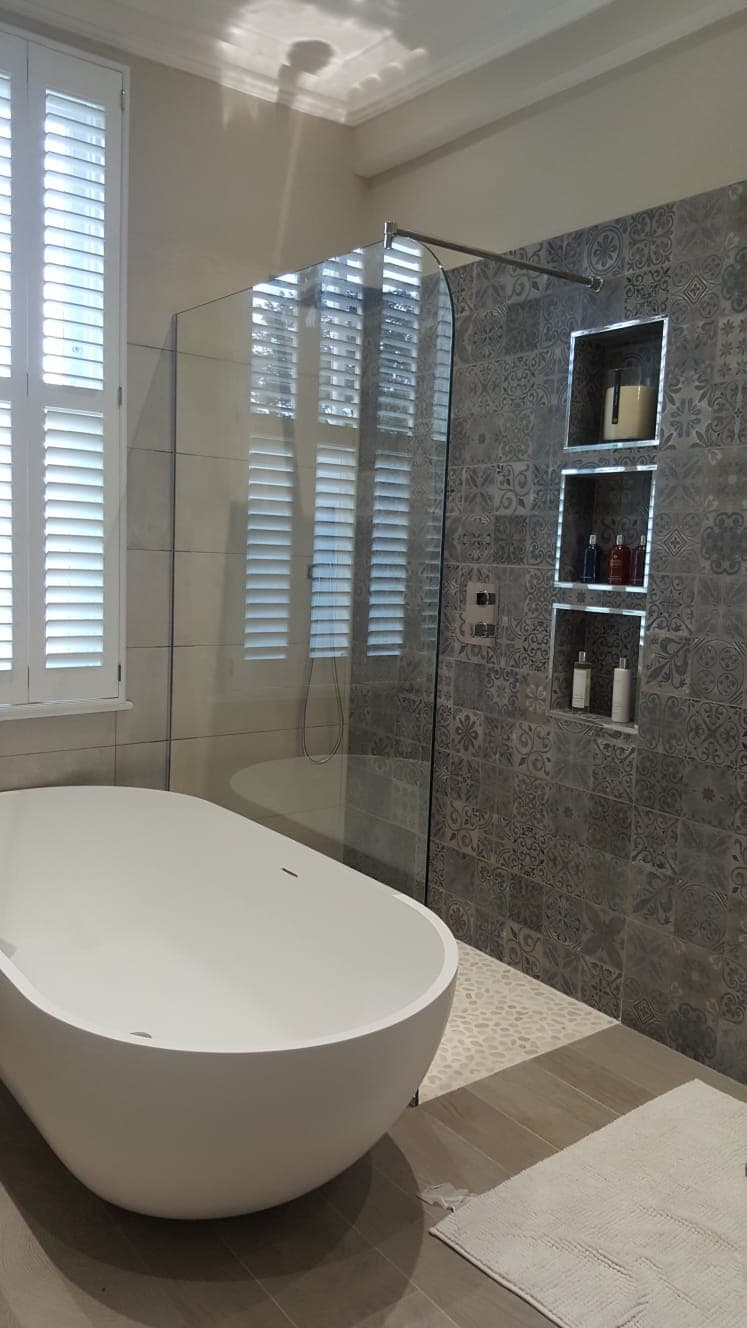
A fixed bath screen is one panel, fixed in place, with nothing that opens. A hinged bath screen swings out of the way when you need the bath. We make four bath layouts: a fixed screen, a fixed panel with a hinged panel beside it, a single hinged panel, and a folding two-panel screen. Every one is toughened 8 or 10 mm glass with polished edges, and every one is priced online in our configurator.
What bath screen layouts can I choose?
A bath screen stands on the rim of the bath. These are the four layouts in our configurator, with the way each one is held:
| Layout | What it is | Panels that move | 700 mm wall-bracket rule |
|---|
| Fixed bath screen | One panel, fixed in place, with nothing that opens | None | Applies |
| Fixed panel and hinged panel | A fixed panel at the tap end with a second panel on hinges beside it | One | Applies to the fixed panel |
| Single panel (hinged) | A single panel on hinges, with nothing fixed beside it | One | Does not apply |
| Folding (two panels) | A panel hinged to the wall with a second panel hinged to it, folding back together | Both | Does not apply |
The glass is the same for all four: clear, grey tint or bronze tint in 8 or 10 mm, or satin and fluted in 10 mm only. Toughening and polished edges are fixed, not options. Our help page on bath screens covers the glass and measuring in more detail.
When does a fixed bath screen make sense?
A fixed screen suits a bath where you are happy for the glass to stay where it is. There is no hinge and no swing to plan for. Before you choose one, think about how you will reach the taps and clean the bath with a panel that does not move, and how much of the bath you want covered.
How a fixed screen is held depends on its width, under our 700 mm rule:
- Up to 700 mm wide: no holes. The panel is held by U-channel only, and there is no option to add a hole.
- 701 mm and over: two holes are added automatically, 200 mm from the top and 200 mm from the bottom, for two SWGC83300 wall brackets, plus the U-channel.
On 8 mm glass the channel is SWCH15X15X15, and on 10 mm it is SWCH20X15X20.
When does a hinged bath screen make sense?
A hinged screen swings out of the way when you need the bath, so the glass is not fixed across the bath all the time. You have two hinged layouts, plus the folding screen below:
- Fixed panel and hinged panel: the fixed panel at the tap end follows the 700 mm rule above, and the second panel swings on hinges beside it.
- Single panel: one panel on hinges with nothing fixed beside it. The 700 mm rule does not apply to it.
A hinged panel is a door as far as the glass is concerned, and a hinged door must be 8 or 10 mm because the hinge has to grip the glass. Check where the panel will swing before you choose, so it clears the basin, toilet and towel rail. The three seals we fit as standard to hinged shower enclosure doors are not part of our bath screens.
What about a folding bath screen?
The folding screen has a panel hinged to the wall and a second panel hinged to it, so the two fold back together. Both panels open, so both are treated as doors and both are 8 or 10 mm. The 700 mm rule does not apply to it. Check the space the two panels need as they fold, against your own bathroom.
Can a bath screen have corner cuts?
Yes, on the fixed bath screen and on the fixed panel of the fixed and hinged screen. A corner cut is a notch taken off a corner of the glass. The hand of the screen decides which edge can take them:
| Hand | Corner cuts allowed |
|---|
| Left hand | Top left, bottom left, or both |
| Right hand | Top right, bottom right, or both |
A cut on the other edge is refused, and the configurator tells you why. If the hand is not set, the first corner cut sets the edge. Read door hand to work out which hand you have.
Where to go next
Choose your bath layout and enter your sizes in the configurator to see the drawing and the live price.
Questions we get asked
What thickness is a bath screen?
Every bath screen we make is 8 or 10 mm toughened glass. Satin and fluted glass come in 10 mm only.
Can a bath screen be made for a curved or P-shaped bath?
Our configurator does not offer curved or P-shaped bath screens. Ask us with your bath's details and a photograph.
How high should a bath screen be?
We make bath screens to your measurements, so the height is yours to choose. Our size guide lists common sizes, and how to measure a shower screen explains the method.
What does a made-to-measure bath screen cost?
The configurator shows the live price for your exact size and options, including VAT. Our article on made-to-measure bath screen cost explains what drives the price.